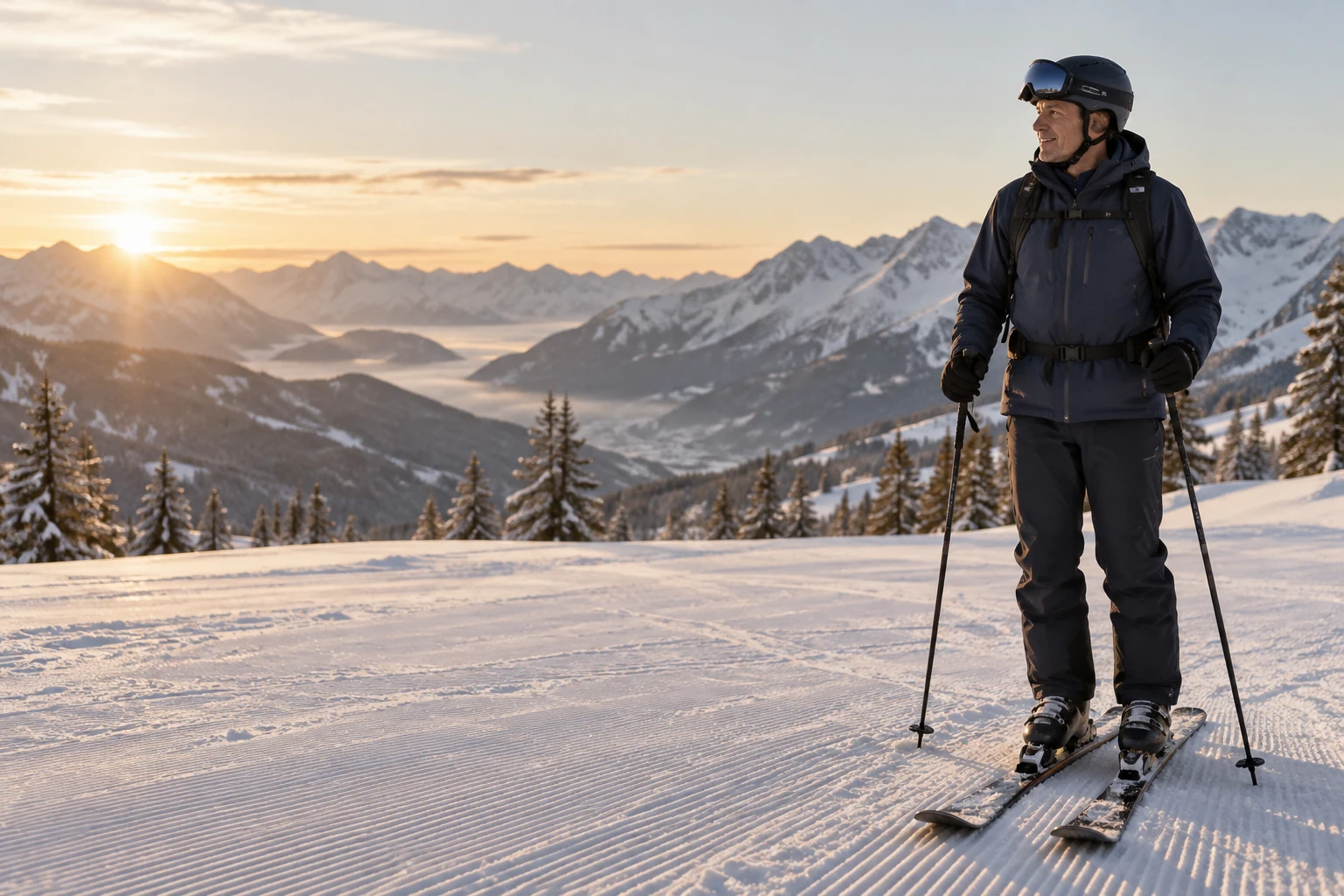
When Can I Ski After Spine Surgery?
Returning to the mountains depends on the operation, your healing, and your ability to respond to unpredictable terrain. A calendar date alone cannot answer the question.
The operation sets the starting point
There is a substantial difference between recovery from a limited microdiscectomy, a lumbar fusion, and a long spinal deformity reconstruction. Neck procedures also require their own assessment, especially when there was spinal cord compression. Skiing should be discussed in terms of the exact surgery and your actual neurological recovery.
Alpine skiing adds risks that a controlled gym session cannot reproduce: a sudden fall, collision, unexpected ice, or a forceful twist. Fatigue affects the ability to manage those situations. The trip also includes lifting equipment, walking in boots, sitting on lifts, and travel. Being comfortable at home does not establish readiness for those combined demands.
Describe your intended skiing honestly. Easy groomed runs, moguls, off-piste terrain, jumps, and racing are different goals. Experience helps with technique but does not remove fall risk. Patients with persistent weakness, impaired balance, osteoporosis, or a long fusion may need lasting changes to how they ski.
What has actually been studied?
A small study of 26 previous skiers after long fusion from the thoracic spine to the pelvis found that 11 returned to skiing, at an average of 2.6 years. Many who returned reported similar or improved aspects of performance. This specific, complex-surgery cohort should not be used to predict recovery after a single-level procedure; it does show why “everyone is back next season” is an unrealistic promise.[1]
Evidence from other sports is indirect. A professional-athlete series after ACDF reported return in 80% of eligible players, averaging 9.5 months. It was not a skiing study, and elite competition is not equivalent to recreational skiing.[2]
Direct research does not provide a universally safe week for skiing after each spine operation. Any timeline should therefore be presented as a planning discussion, with clearance based on healing and function.
How to plan the next season
These are planning windows, not automatic clearance dates. The sport-specific progression below is a practical framework to individualize with your surgeon and physical therapist; it has not been validated as a single research protocol.
| Stage to discuss | Focus and expectations |
|---|---|
| First 6 weeks after surgery | Focus on protected daily mobility and walking. Skiing and ski-specific impact training are not part of this early phase. |
| 6–12 weeks after a nonfusion procedure | Discuss rehabilitation and rebuild strength and endurance. This is a preparation period, not automatic slope clearance. |
| Around 3–6 months after limited nonfusion surgery | For an uncomplicated recovery, this can be a window to discuss whether a controlled return is realistic. Persistent symptoms or deficits can move the plan substantially later. |
| Around 6–12 months or later after fusion | Use this as a conservative planning discussion, not a promised return date. The surgeon must consider the operation, healing, neurological function, and fall consequences. |
| After long fusion or complex reconstruction | Recovery can extend well beyond a year. A return may be modified, delayed substantially, or inadvisable for some patients. |
The ranges above are proposed planning windows, not rates or recommendations established by a skiing trial. Do not book a nonrefundable trip around the earliest date. Dr. Jalali’s general instructions place formal therapy no earlier than six weeks after nonfusion surgery and three months after fusion.[3]
What should be in place before snow?
Ask your surgeon and therapist to evaluate the skills you will need, rather than relying on a pain score alone. Adequate healing, stable neurological findings, and the ability to perform permitted exercise without a prolonged flare are central. After fusion, imaging may be part of the decision, but does not replace a functional assessment.
- Leg strength and endurance for repeated controlled turns, with no giving way or concerning asymmetry.
- Balance and coordination adequate for a moving, unpredictable environment.
- Enough comfortable neck movement and awareness to look around safely, particularly after cervical surgery.
- The ability to manage boots, transfers, and equipment within your restrictions—or a plan for assistance.
- No sedating medication that impairs alertness or reaction time.
- A clear agreement about terrain, duration, and when to stop.
Ski conditioning should be prescribed within your restrictions. Do not test jumps, loaded twisting, or fall recovery maneuvers before your team has approved them. Clearance for skiing is not necessarily clearance for terrain parks or high-speed racing.
Make the first ski day deliberately modest
After clearance, choose familiar, easy terrain and favorable conditions. Begin with a short session and allow a generous margin before fatigue. Avoid using the first day to prove that you can still ski your previous itinerary. A lesson focused on adapting technique can be useful if movement has changed.
Plan assistance with heavy gear, allow breaks during travel, and keep the first trip flexible. Stop for new radiating pain, weakness, altered balance, or symptoms that change how you turn. A helmet and appropriate equipment remain important, but neither makes a recovering spine immune to a fall.
Common questions
Is cross-country skiing safer?
Different styles change the demands rather than eliminate them. Nordic skiing may involve fewer high-speed descents but still requires endurance, balance, and repetitive trunk movement. Discuss the specific activity instead of assuming one category is automatically permitted.
What if I feel fully recovered early?
That is encouraging, but symptom relief and structural healing are not identical. Keep follow-up appointments and obtain activity-specific clearance.
Will a fusion prevent all skiing?
Not necessarily. Some patients return, including after extensive operations. The decision depends on the recovery and the risks of the intended terrain, not simply whether hardware is present.
When to stop
Seek emergency care for new urinary retention, new loss of bladder or bowel control, new numbness in the saddle area, or rapidly worsening leg weakness. New foot drop, increasing radiating pain, or a significant decline in walking deserves prompt clinical assessment. After surgery, contact the team for fever, drainage, or increasing wound redness.
After cervical surgery, new arm weakness or worsening balance also warrants prompt assessment. Significant symptoms after a fall should be evaluated rather than tested with another run.
References & further reading
- Holuba K, et al. Is it possible to return to skiing following long-construct spinal deformity surgery? Spine Deformity. 2025;13:911–919. Updated publisher version.
- Watkins RG IV, et al. Return to Play After Anterior Cervical Discectomy and Fusion in Professional Athletes. Orthopaedic Journal of Sports Medicine. 2018;6(6).
- Omid Jalali, MD. Postoperative instructions. Practice guidance.
Get back to what moves you.
Discuss your activity goals with Omid Jalali, MD, orthopedic spine surgeon at Community Orthopedic Medical Group in Mission Viejo, serving Orange County.
Request an appointment →