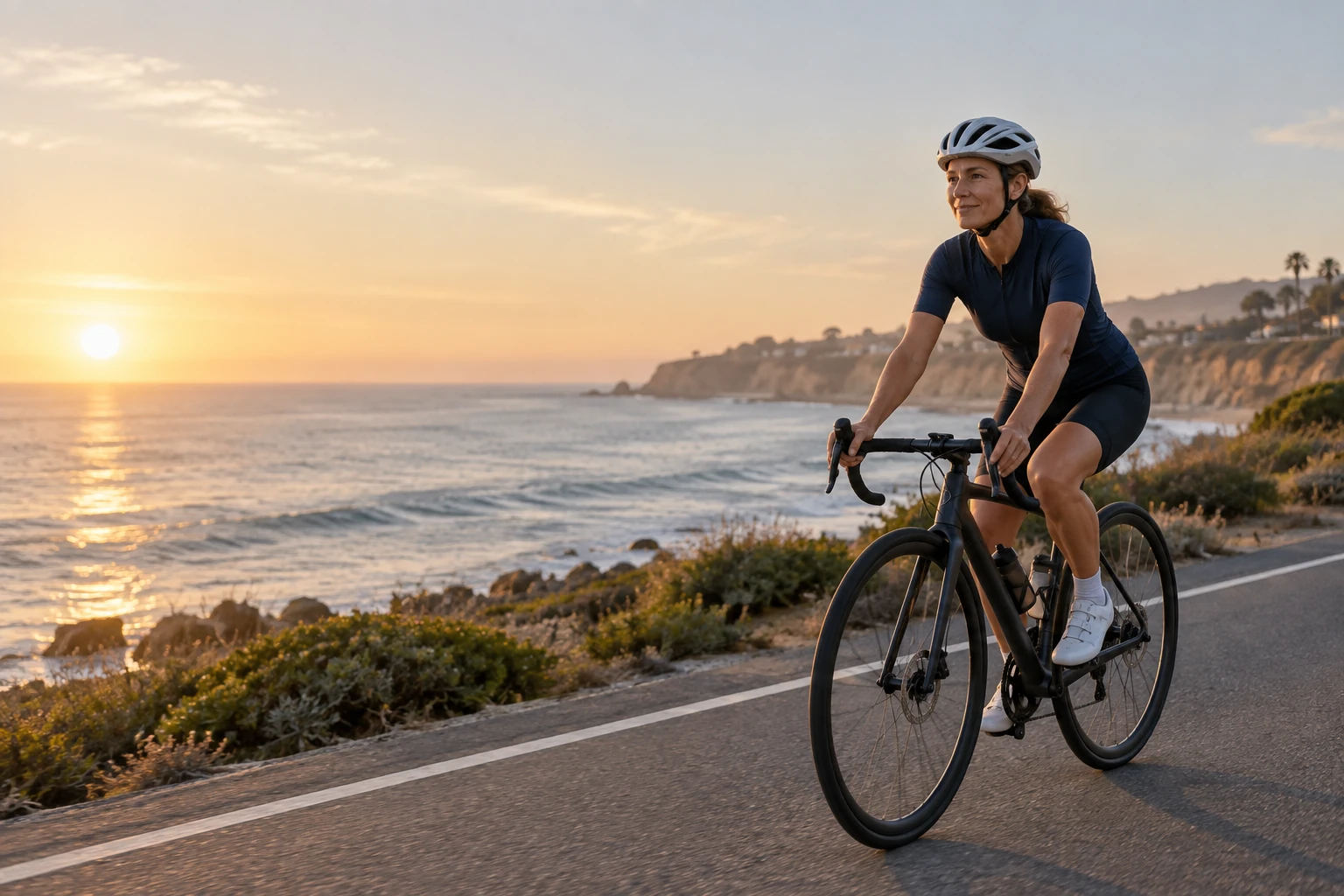
Cycling After Lumbar Fusion: From the Stationary Bike to the Road
Cycling can be part of an active life after lumbar fusion. Start by separating controlled indoor exercise from outdoor riding, where balance, braking, terrain, and falls change the demands.
What kind of cycling are you returning to?
Ten minutes on a stable exercise bike, an easy neighborhood ride, and a long road or mountain-bike session should be treated as different milestones. After lumbar fusion, the operation, healing, symptoms, and your preoperative fitness all influence the progression. A short fusion and a long reconstruction do not have the same movement demands.
Fusion relies on bone healing between vertebrae. Screws and rods provide support during that process, but their presence does not mean the recovery is complete. Your surgeon follows symptoms, examination, and, when appropriate, imaging to decide how activity can advance.[2]
A stationary bike removes much of the uncertainty of traffic and terrain, but it still requires comfortable sitting, a tolerable position, and safe mounting and dismounting. Outdoor riding adds sudden braking, road vibration, shoulder checks, and the possibility of a fall. A bike that felt ideal before surgery may need a fit adjustment as mobility and conditioning change.
What do the cycling studies show?
In a small retrospective study, all 10 patients who had participated in recreational bicycling returned after lumbar fusion. Across the study’s cycling, swimming, and golf groups, return occurred within three to nine months. The study was too small to estimate an individual’s chance of success or establish a safe return date for road racing or mountain biking.[1]
This is encouraging evidence for the possibility of return, not a guarantee of returning to the same mileage or terrain. The available research does not identify a universally safe saddle position, resistance setting, or number of weeks before outdoor riding. A staged progression should be individualized.
A practical cycling progression
These are planning windows, not automatic clearance dates. The sport-specific progression below is a practical framework to individualize with your surgeon and physical therapist; it has not been validated as a single research protocol.
| Stage to discuss | Focus and expectations |
|---|---|
| First 6 weeks | Walking and prescribed daily mobility are the foundation. Follow lifting and movement restrictions; do not assume stationary cycling is permitted simply because it is low impact. |
| 6–12 weeks | At follow-up, ask whether brief, low-resistance stationary cycling is appropriate. Approval depends on the procedure, symptoms, and ability to get on and off safely. |
| Around 3 months | Formal fusion rehabilitation may begin if cleared. Build comfortable indoor duration and control before resistance or outdoor exposure. |
| 3–6 months | Some uncomplicated recoveries may progress to short, flat outdoor rides after specific clearance and demonstrated bike handling. Others should continue indoors longer. |
| 6–12 months and beyond | Long rides, sustained climbing, rough trails, fast groups, and competition require further conditioning and a separate risk discussion. |
These dates describe questions to raise, not permission to ride. Dr. Jalali’s instructions place formal physical therapy no earlier than three months after fusion. Early activity remains limited by the prescribed lifting and movement precautions.[3]
Make the bike fit the recovery
Once cycling is approved, start with a setup that lets you sit comfortably without reaching or holding an extreme posture. An upright or recumbent bike may be useful, but neither is automatically best for every patient. The ability to enter and exit the machine safely matters as much as the riding position.
A therapist or experienced fitter can help assess handlebar reach, saddle position, and whether your posture changes with fatigue. Avoid chasing an aerodynamic position at the expense of comfort. Do not force extra movement through the lower back to compensate for a stiff hip or an unsuitable setup.
- Begin with low resistance and a short session agreed with your team. Increase comfortable duration before hard resistance or intervals.
- Stay seated initially unless your clinician has approved standing efforts. A low-impact activity can still become demanding at high resistance.
- Keep mounting, dismounting, and handling the bicycle within your restrictions. Lifting a bike onto a vehicle rack may exceed the permitted load.
- Check for new radiating pain, numbness, or weakness. Stop and discuss these rather than changing the saddle repeatedly to ride through them.
- Use the next-day response to guide progression; repeated flares mean the current dose needs review.
Readiness for the first outdoor ride
Before leaving the stationary bike, you should be able to control the bicycle, brake promptly, look around, and put a foot down confidently. Residual foot weakness, altered sensation, balance problems, or sedating medication can make outdoor riding inappropriate even when pedaling feels comfortable.
After clearance, choose a short, familiar, flat route with minimal traffic and an easy way to stop. A solo effort with a companion nearby may be easier to control than joining a fast group. Hills, rough surfaces, clipless-pedal challenges, and long distances can be added separately once the basics are repeatable.
An electric bike may reduce the effort of climbing, but its weight, speed, and handling can introduce other demands. Assistance does not remove fall risk or the need for clearance.
Common questions
Is cycling better than walking?
They serve different purposes. Walking is an early foundation in the postoperative instructions. Cycling may later complement it, but comfort on a bike does not prove readiness for all other activity.
Can I use a spin class as rehabilitation?
A class can make it tempting to match resistance, standing intervals, and duration before you are ready. Begin with an individualized session where you control the effort and can stop easily.
Will I need to change my riding style permanently?
Some people return to familiar riding; others prefer shorter outings or a more comfortable position. The number of levels fused, other joint conditions, and your goals influence the answer.
When to seek help
Seek emergency care for new urinary retention, new loss of bladder or bowel control, new numbness in the saddle area, or rapidly worsening leg weakness. New foot drop, increasing radiating pain, or a significant decline in walking deserves prompt clinical assessment. After surgery, contact the team for fever, drainage, or increasing wound redness.
Read more about spine rehabilitation and bring details of your bike and usual routes to the recovery discussion.
References & further reading
Get back to what moves you.
Discuss your activity goals with Omid Jalali, MD, orthopedic spine surgeon at Community Orthopedic Medical Group in Mission Viejo, serving Orange County.
Request an appointment →