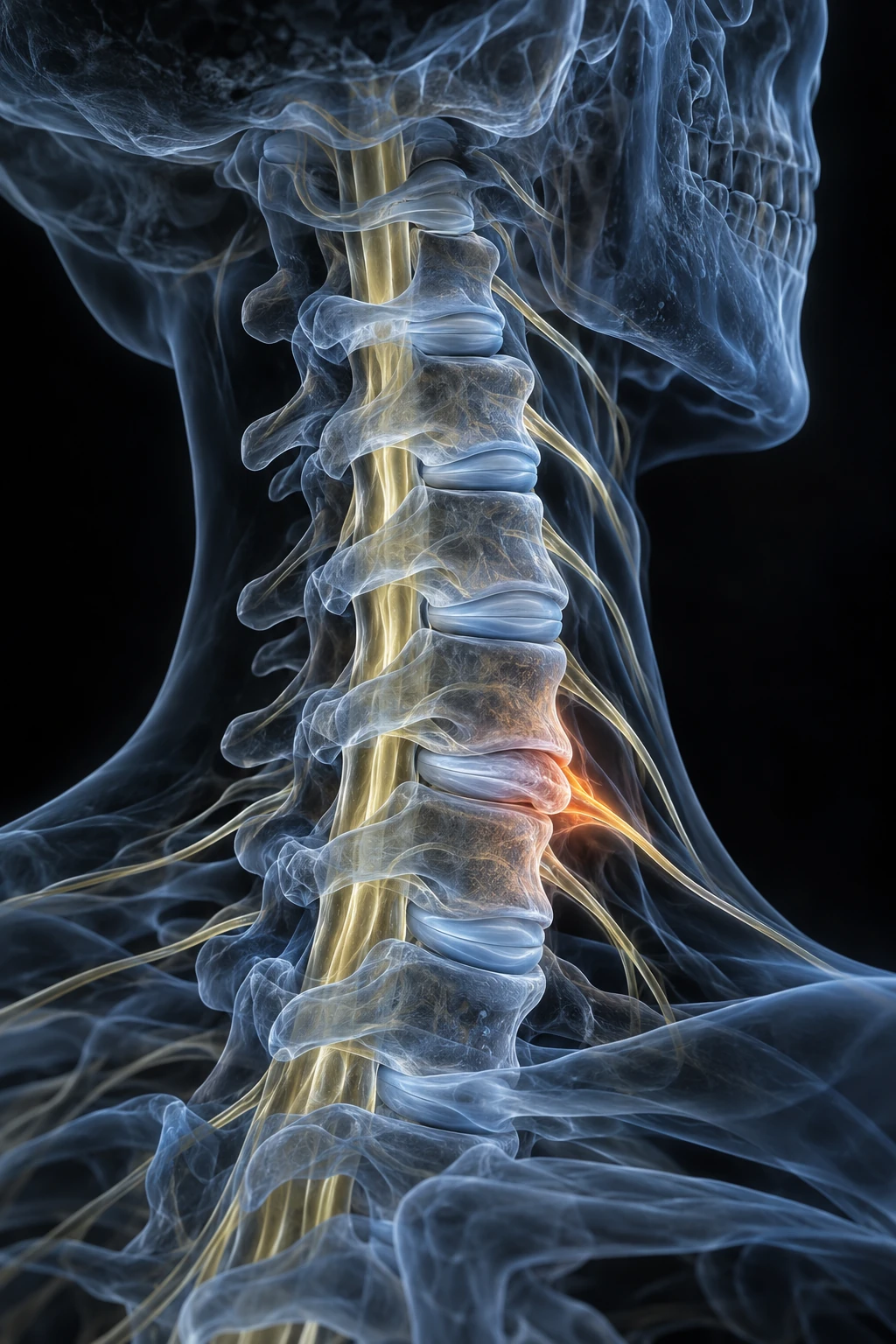
THE ATHLETIC SPINE / CERVICAL SPINE SURGERY
Cervical Disc Replacement
Relieve pressure. Preserve motion when appropriate.
An alternative to fusion for selected patients with a damaged cervical disc and nerve or spinal cord compression.
Omid Jalali, MD · Orthopedic Spine Surgeon
Mission Viejo · Orange County
What is cervical disc replacement?
Cervical disc replacement removes a damaged disc from the neck and replaces it with an artificial disc designed to allow movement at that level. It is also called cervical disc arthroplasty. The surgeon first relieves pressure on the nerves or spinal cord; the implant then supports the space between the vertebrae while permitting controlled motion.
Disc replacement and ACDF can address some of the same symptoms, but they accomplish stabilization differently. Preserving movement is useful only when the surrounding joints, bones, and alignment can support it. The best operation is the one that fits your anatomy and diagnosis.
Watch on YouTube ↗
When might it help?
Disc replacement may help selected patients with cervical disc herniation or degenerative disc disease causing arm pain, numbness, or weakness. Some patients with spinal cord compression may also be candidates, depending on the extent and location of their disease.
Persistent nerve-related symptoms
Pain traveling into the shoulder, arm, or hand can interfere with sleep, work, and exercise. If appropriate nonsurgical care has not provided enough relief, removing the compressive disc may be considered. Progressive weakness or changes in walking and hand coordination need prompt assessment.
A segment that can still move well
The treated level needs suitable alignment, bone quality, and supporting joints. Advanced facet arthritis, marked instability, severe collapse, or poor bone quality may favor a different approach. The number of levels and the specific implant’s indications also matter.
Choosing between replacement and fusion
Dr. Jalali will review your examination, MRI, and X-rays, including motion studies when helpful. ACDF or posterior decompression may be a better fit in some cases. Disc replacement does not promise normal neck motion or prevent every future spinal problem.
Defining meaningful improvement
The goal is relief of symptoms from the treated level and a return toward your usual activities. Longstanding numbness or weakness can persist despite adequate decompression. Isolated neck pain without a clear treatable cause requires particular care in deciding whether surgery is appropriate.
RELATED CONDITIONS
What happens during surgery?
Under anesthesia, an incision at the front of the neck provides access to the affected disc. The disc and compressive bone spurs are removed, and the nerve openings and spinal canal are assessed. The surgeon prepares the space and places an artificial disc sized to your anatomy.
Implant selection and positioning
Different implants have different designs and eligibility criteria. Imaging helps check the position during surgery. The discussion before surgery should cover the planned levels, why replacement is suitable, and whether findings could require a change in plan.
Recovery is a gradual return to activity.
Walking generally begins early. Some patients return home the day of surgery; others need an overnight stay. Temporary throat discomfort, swallowing difficulty, or hoarseness can occur after an anterior approach.
Work, driving, exercise, and physical therapy progress according to your symptoms and follow-up findings. There is no fusion to wait for at the replaced level, but the surgical tissues still need time to heal. Avoid treating early pain relief as clearance for unrestricted lifting or sport.
Understand the tradeoffs.
Risks include infection, bleeding, nerve or spinal cord injury, swallowing or voice problems, implant migration or wear, and persistent symptoms. Bone can develop around the implant and restrict motion. Further surgery, including conversion to fusion, may be necessary.
YOUR QUESTIONS, ANSWERED
Before you decide.
Does an artificial disc last forever?
Implants are intended for long-term use, but wear, loosening, or changes around the disc can occur. Follow-up and an individual discussion of durability are important.
Can more than one level be replaced?
Some patients qualify for replacement at more than one level. Eligibility depends on the device, the pattern of disease, and the condition of each segment.
Is this always better than ACDF?
No. Fusion may provide a more appropriate solution when alignment, arthritis, instability, or other factors make motion preservation unsuitable.
Further patient education: AAOS: cervical surgery options
General education to support a conversation with your surgeon. Follow the instructions provided for your individual care.
LESS PAIN. BETTER MOVEMENT. ACTIVE LIFE.
Start with a conversation.
Bring your questions, your goals, and your prior imaging. Together, we can discuss which options fit your diagnosis and the activities you want to return to.
Request an appointment →Community Orthopedic Medical Group
26401 Crown Valley Pkwy #101, Mission Viejo, CA