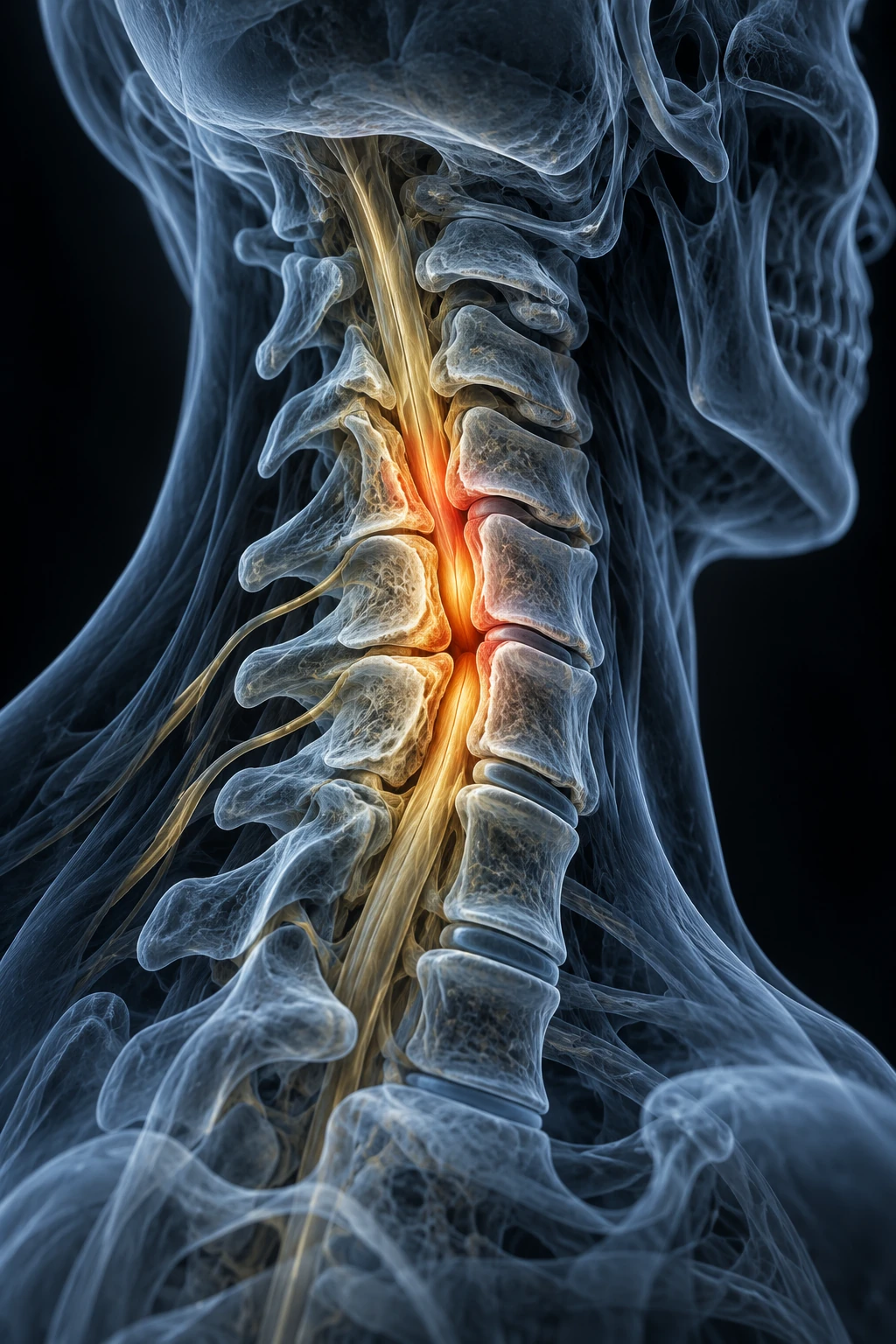
THE ATHLETIC SPINE / CERVICAL SPINE SURGERY
Cervical Laminectomy & Fusion
More room for the spinal cord. Support for the neck.
A posterior operation that combines decompression with stabilization when both are needed.
Omid Jalali, MD · Orthopedic Spine Surgeon
Mission Viejo · Orange County
What is cervical laminectomy & fusion?
A cervical laminectomy removes portions of the bony roof of the spinal canal to create more space for the spinal cord. Fusion joins selected vertebrae and supports their alignment after decompression. Screws and rods hold the spine while bone graft develops into a solid connection.
The operation is performed from the back of the neck. It is commonly considered for compression involving several levels when the overall pattern of disease and spinal alignment favor a posterior approach.
Watch on YouTube ↗
When might it help?
The combination may help when cervical stenosis compresses the spinal cord and the neck also needs stabilization. Treatment planning considers how many levels are involved, where compression occurs, and whether the spine can safely maintain its alignment after decompression.
Hand coordination, balance, and walking changes
Cervical myelopathy can make hands clumsy, cause difficulty fastening buttons, or lead to unsteady walking and leg stiffness. Surgery aims to prevent further neurological decline and may improve function. Existing cord damage is not always reversible, which makes timely assessment important.
Compression across several levels
A posterior decompression may provide room across a broader area of the neck. It is not the best approach for every multilevel problem; a markedly forward-curved neck or compression that needs direct anterior removal may call for a different strategy.
When decompression needs added stability
Instability, the extent of bone removal, and the risk of losing alignment can support adding fusion. The decision should explain why stabilization is useful rather than assuming every decompression requires it.
Weighing alternatives and expectations
Dr. Jalali will discuss whether laminoplasty, an anterior procedure, or a combined operation better fits your anatomy. Relief of nerve symptoms, protection of spinal cord function, and expected changes in neck motion are distinct goals. The plan should account for bone health, prior surgery, and your recovery support.
RELATED CONDITIONS
What happens during surgery?
Through a posterior incision, the surgeon exposes the involved levels and removes the laminae and other tissue causing compression. Nerve openings may also be enlarged when needed. Fixation and bone graft stabilize the planned fusion levels.
Planning the length of the fusion
The construct may span several cervical levels and sometimes extend into the upper thoracic spine. The choice reflects alignment and the support needed, rather than a standard length used for everyone.
Recovery is a gradual return to activity.
A hospital stay is typically needed. Early care focuses on pain control, walking, wound care, and safe daily tasks. Muscular soreness behind the neck can take time to settle. A collar may be prescribed depending on the construct and your surgeon’s plan.
Neurological recovery can continue over months, while fusion healing requires follow-up. Lifting, driving, work, and rehabilitation are advanced individually. Discuss the practical impact of reduced motion at the fused levels before surgery.
Understand the tradeoffs.
Risks include infection, bleeding, spinal fluid leak, nerve or spinal cord injury, incomplete neurological recovery, failure of fusion, and implant problems. Weakness around the shoulder or upper arm, sometimes called C5 palsy, can occur after cervical decompression. Adjacent levels can develop problems over time.
YOUR QUESTIONS, ANSWERED
Before you decide.
Why add fusion to a laminectomy?
Fusion may help maintain stability and alignment when decompression alone would not provide sufficient support.
Will my balance return to normal?
It may improve, but the extent of recovery depends in part on existing spinal cord injury and other health conditions. Preventing further decline may be the central goal.
How much motion will I lose?
This depends on the levels fused and your motion before surgery. Ask how the proposed construct affects activities such as driving.
Further patient education: AAOS: spinal fusion · HSS: cervical laminoplasty and alternatives
General education to support a conversation with your surgeon. Follow the instructions provided for your individual care.
LESS PAIN. BETTER MOVEMENT. ACTIVE LIFE.
Start with a conversation.
Bring your questions, your goals, and your prior imaging. Together, we can discuss which options fit your diagnosis and the activities you want to return to.
Request an appointment →Community Orthopedic Medical Group
26401 Crown Valley Pkwy #101, Mission Viejo, CA